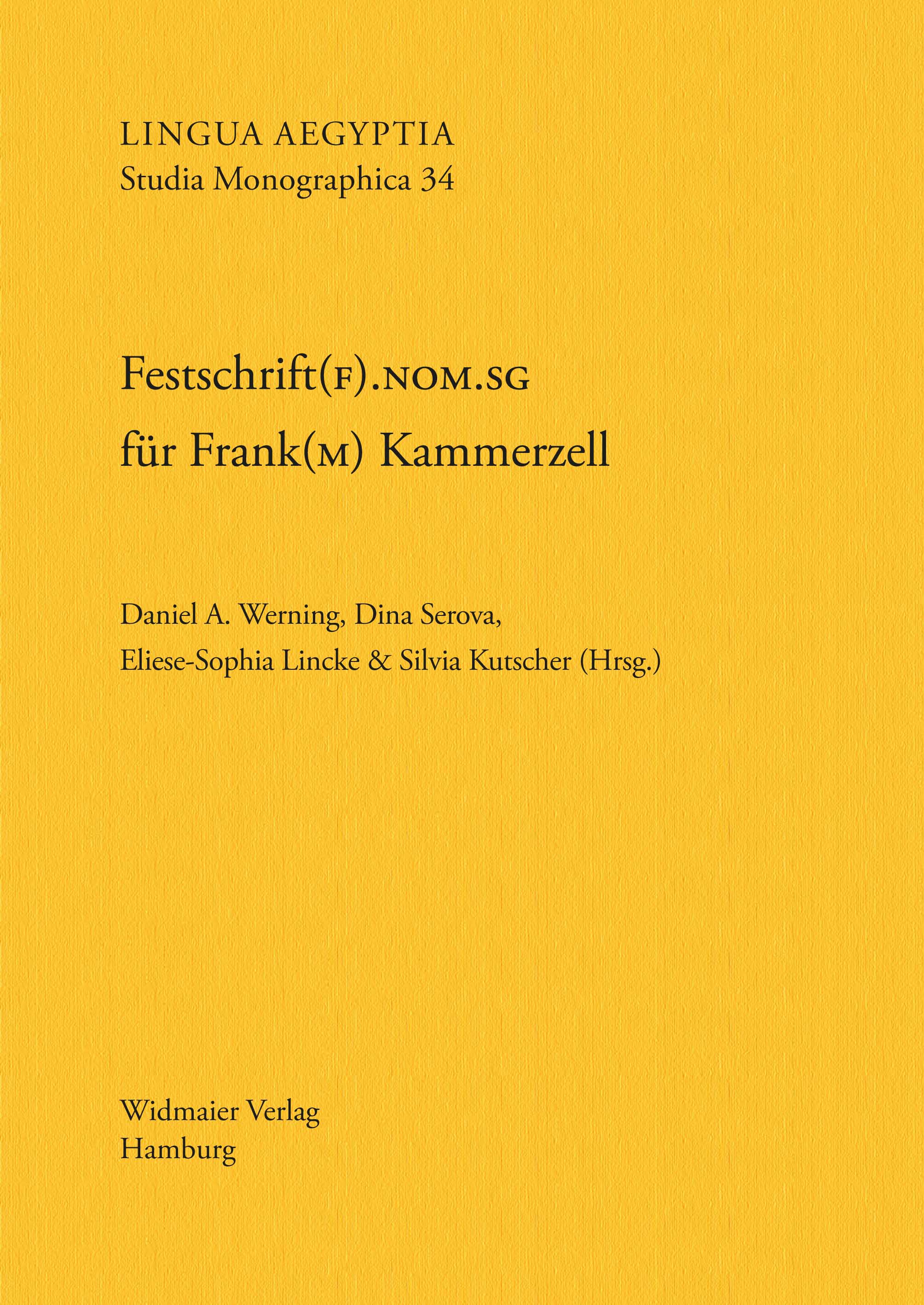
Daniel A. Werning, Dina Serova, Eliese-Sophia Lincke & Silvia Kutscher (eds)
Festschrift(f).nom.sg für Frank(m) Kammerzell
Lingua Aegyptia Studia Monographica 34
Hamburg, to be published in December 2026
doi: https://doi.org/10.37011/studmon.34
xxiv+813 p., colour and b&w illustrations, hardcover, ca. 1600 g.
ISSN: 0946-8641
ISBN 978-3-943955-34-7
- Pre-order Price (valid from November 2026 until December 2026)
Shipping: free (Germany), reduced rate (worldwide) 75.00 € - Price (valid from December 2026) 99.00 €
- Reduced price for subscribers to LingAeg (Journal) (valid from December 2026) 75.00 €
- NOTICE:
Choose your subscription type when entering your billing information.
All prices incl. VAT 7% and excl. shipping. Orders from non-EU customers and from VAT registered customers (EU) will be exempt from German VAT.
Description
Vorwort
ix-xiii
Schriftenverzeichnis von Frank Kammerzell
xv-xxiv
Niv Allon,
Erasing Seth. The Seth Classifier in Eighteenth Dynasty Books of the Dead
DOI: https://doi.org/10.37011/studmon.34.01
1-13
Petra Andrássy,
Eine Passage aus dem Dahschur-Dekret Pepis I. neu interpretiert
DOI: https://doi.org/10.37011/studmon.34.02
15-35
Anke Ilona Blöbaum & Hans-Werner Fischer-Elfert,
Der Schreiber Thutmose und seine Amulette. Zu Inventar, Typologie und Pragmatik eines privaten Güterverzeichnisses (pWien KHM ÄS 10321 rt. Kol. 4-7)
DOI: https://doi.org/10.37011/studmon.34.03
37-78
Vera Blumenthal,
Hieroglyphen sind eine Bilderschrift und in Pyramiden verbergen sich sagenhafte Schätze. Zur problematischen Darstellung des Alten Ägypten in zwei Lehrwerken für den Schulunterricht
DOI: https://doi.org/10.37011/studmon.34.04
79-105
Julia Budka,
Von Käfern und Menschen. Ambivalente Befunde aus TT 414 (Asasif)
DOI: https://doi.org/10.37011/studmon.34.05
107-121
Gaëlle Chantrain,
Body Part-Based Metaphors in Ancient Egyptian and Some African Languages. A ‘Teaser’ Study
DOI: https://doi.org/10.37011/studmon.34.06
123-147
Camilla Di Biase-Dyson & Melanie Glöckner,
On Abbreviation in Medical Texts. Some Observations on Scribal Practice
DOI: https://doi.org/10.37011/studmon.34.07
149-173
Rebecca Döhl,
Bild, Text, Raum. Die Schlacht von Kadesch als multimodales Kommunikat
DOI: https://doi.org/10.37011/studmon.34.08
175-231
Eva-Maria Engel,
Die Inschriften aus der Zeit des Semerchet. Kontext und Themen
DOI: https://doi.org/10.37011/studmon.34.09
233-258
Manuela Gander,
Sphingen im Warmen. Unbekannte Aegyptiaca in brandenburgischen Sammlungen
DOI: https://doi.org/10.37011/studmon.34.10
259-271
Orly Goldwasser & Yànrú Xú,
Disambiguating Pronouns in Ancient Egyptian and Modern Mandarin Chinese Scripts. A Comparative Analysis of Gender
DOI: https://doi.org/10.37011/studmon.34.11
273-289
Haleli Harel,
A Network of Verbal Borrowing. Sketching Verbs and Deverbals of Foreign Origin in Ancient Egyptian Texts of the New Kingdom
DOI: https://doi.org/10.37011/studmon.34.12
291-312
Jana Helmbold-Doyé,
Schöner Schein - was bleibt. Überlegungen zu römerzeitlichen Bestattungen in Ägypten
DOI: https://doi.org/10.37011/studmon.34.13
313-349
Kristina Hülk,
Überlegungen zum sogenannten „brutalen Realismus“ in der kuschitischen Kunst der 25. Dynastie
DOI: https://doi.org/10.37011/studmon.34.14
351-376
Barbara Kündiger,
Rezeption und Inspiration. „Das ist alles nur geklaut und gestohlen, nur gezogen und geraubt. Entschuldigung, das hab’ ich mir erlaubt“
DOI: https://doi.org/10.37011/studmon.34.15
377-439
Renata Landgráfová & Jiří Janák,
Praising Tatenen on New Year’s Day on the Northern Interior Side of the Inner Sarcophagus of Iufaa
DOI: https://doi.org/10.37011/studmon.34.16
441-457
Marc Loth,
Langlebige Löwen. Zur neuzeitlichen Rezeption der ägyptischen Löwenstatuen in der Skulpturensammlung Dresden
DOI: https://doi.org/10.37011/studmon.34.17
459-496
Matthias Müller,
Von s-, t- und k-Kausativen. Kausativzyklen in der ägyptisch-koptischen Sprache
DOI: https://doi.org/10.37011/studmon.34.18
497-542
Vera Müller,
Die Göttin Mafdet und ihr Bezug zum regierenden König in der 1. Dynastie
DOI: https://doi.org/10.37011/studmon.34.19
543-557
Winfried Nöth,
Linguistic Iconicity Since F. de Saussure and C. S. Peirce
DOI: https://doi.org/10.37011/studmon.34.20
559-573
Carsten Peust,
Zur Entwicklung der unbetonten Vokale im Ägyptisch-Koptischen
DOI: https://doi.org/10.37011/studmon.34.21
575-616
Tonio Sebastian Richter,
ⲃⲣⲁⲭⲙⲁⲛ[..]
DOI: https://doi.org/10.37011/studmon.34.22
617-623
Dina Serova,
Schriftsprachliche Kommunikation im Alten Ägypten und heute: von Emojis und Hieroglyphen
DOI: https://doi.org/10.37011/studmon.34.23
625-669
Heike Sternberg-el Hotabi,
„An diesem Ort werde ich Frieden geben“. Ein Bauplan der alten Steinheimer Synagoge (1884)
DOI: https://doi.org/10.37011/studmon.34.24
671-675
David A. Warburton,
Writing, Language & Thought
DOI: https://doi.org/10.37011/studmon.34.25
677-762
Anke Weber,
Neuigkeiten zur Ausrichtung der Sarkophage von Ramses III. Aktuelle Erkenntnisse aus den Grabungsarbeiten der Winterkampagne 2024/25 des The Ramesses III (KV 11) Publication and Conservation Project
DOI: https://doi.org/10.37011/studmon.34.26
763-782
Daniel A. Werning,
Frequencies of Hieroglyphic Signs and Sign Functions
DOI: https://doi.org/10.37011/studmon.34.27
783-813